Infectious waste management: reducing the environmental impact of healthcare activities
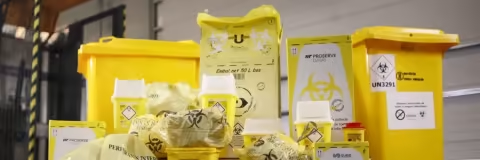
Infectious waste management: an environmental challenge that goes beyond treatment
Managing infectious waste generated by healthcare activities represents a sanitary, logistical and environmental challenge. According to the World Health Organization (WHO), approximately 85% of waste generated by healthcare activities is non-hazardous, while the remaining 15% presents potential risks, particularly infectious, chemical or radioactive hazards.
This distinction is essential: not all waste generated within a healthcare facility requires the same level of precaution or the same treatment methods. Appropriate waste characterisation and segregation at the point of generation help prevent non-hazardous waste from being unnecessarily directed into specialised waste streams, which are often subject to more stringent requirements.
Healthcare waste presenting an infectious risk occupies a particular place in this system. Its management must prevent exposure risks for healthcare professionals, collection workers and treatment staff, while complying with the applicable regulatory requirements.
Environmental considerations come into play at every stage: resource consumption, packaging, storage, transport and final treatment. The environmental impact of a waste management stream therefore cannot be assessed solely on the basis of its treatment technology.
The environmental limitations of traditional waste management routes
Incineration is an important route for the disposal of infectious waste. It makes it possible to treat waste presenting specific risks, but its environmental performance depends in particular on the facilities used, combustion conditions, flue gas treatment and residue management.
The WHO points out that open burning and low-temperature incineration can, under certain circumstances, lead to emissions of dioxins, furans and particulate matter. This does not mean that all incineration facilities have the same environmental performance: compliant industrial equipment, when properly operated, meets specific emissions control requirements.
Beyond the treatment process itself, logistics are another factor to consider. In a system based on outsourced treatment, waste must be packaged, stored and then transported to a specialised facility. These operations require human and material resources, generate vehicle movements and demand rigorous organisation to maintain safety throughout the entire process.
Reducing the environmental impact of infectious healthcare waste therefore requires consideration of its entire journey, not just its final disposal.
On-site treatment: rethinking the organisation of infectious healthcare waste management
Treating waste directly within the healthcare facility where it is generated offers an alternative approach to centralised waste management systems. The principle is to carry out a pre-treatment stage for infectious waste close to the point of generation, before directing it to an appropriate disposal route.
This approach can offer several operational and environmental benefits:
- Reducing the transport of untreated waste: on-site pre-treatment can reduce the volumes transported to specialised facilities and, depending on the organisation in place, the frequency of collections.
- Reducing storage constraints: the reduction in waste volume following treatment can make it easier to manage dedicated waste storage areas.
- Controlling handling operations: treating waste close to where it is generated helps limit certain handling and transport operations before disinfection.
- Better integrating treatment into the facility's operational requirements: the volumes generated, operating hours and logistical capacities can all be taken into account when organising day-to-day operations.
These potential benefits must nevertheless be assessed in relation to several factors: equipment energy consumption, treatment capacity, maintenance, team organisation and the fate of waste following pre-treatment.
On-site treatment does not mean that the entire logistics chain disappears. Treated residues must still be directed to an authorised disposal or recovery route, in accordance with local regulatory requirements.
What role can disinfection pre-treatment technologies play?
Several technologies are now available for treating infectious waste directly within healthcare facilities. Among these, processes combining shredding and microwave disinfection offer an alternative to thermal treatment through combustion.
These systems are designed to reduce the infectious risk associated with waste before it is sent to an appropriate waste management route. Their main advantage lies in the possibility of bringing the pre-treatment stage closer to the point of generation and reducing the volume of waste to be managed.

This is the category in which Sterilwave operates. Its systems combine shredding and microwave technology to treat infectious healthcare waste on site. Depending on the model, waste volume reduction can reach 85%. This feature can help optimise storage conditions and reduce the volumes transported.
However, choosing a piece of equipment cannot be based solely on its waste volume reduction capacity. It must be assessed according to the categories of waste it can accept, the daily volumes to be processed, installation constraints, available resources and applicable regulatory requirements.
Towards a more comprehensive approach to healthcare waste management
Reducing the environmental footprint of healthcare waste first requires a comprehensive approach that considers the entire waste management stream.
The first priority is to prevent waste generation wherever possible, without compromising patient safety. Waste segregation at source is also a key factor: it makes it possible to distinguish genuinely hazardous waste from waste that can be treated as non-hazardous and direct each category towards the appropriate waste management route.
The next steps involve choosing the treatment method, optimising logistical flows and assessing the associated impacts. To objectively compare different approaches, several indicators can be monitored: waste volumes generated, quantities of infectious healthcare waste, energy consumption during treatment, kilometres travelled, collection frequency and the final destination of treatment residues.
This approach avoids considering any single technology as a universal solution. The needs of a hospital, a laboratory or a smaller healthcare facility are not necessarily comparable.
The challenge for healthcare facilities is therefore to develop an organisation suited to their activities, combining infectious risk management, regulatory compliance and a measurable reduction in their environmental impact.
Sources
- World Health Organization (WHO) – Health-care waste, 24 October 2024.
- United Nations Environment Programme (UNEP) – Global Waste Management Outlook 2024.
On the same subject

Technology
